Showing posts with label book review. Show all posts

Friday, May 8, 2009

Really Good Cookies

Tomorrow is the annual Bake & Book Sale for the Royalton Friends of the Library. Our friends are the best ~ few but feisty! ~ and provide funds every year for the prize books, craft supplies, and other things we need for the Summer Reading Program. Don't know what we'd do without them.

For the bake sale, I'm making the Giant Chocolate Sugar Cookies from Martha Stewart's Cookies, (c) 2008.  A mere test-drive with the library copy was not enough to satisfy me, so I purchased the book a couple of weeks ago. There are many recipes that look frankly amazing, but this is the only one I've tried so far. I made these cookies last week for a get-together at Jane's house. Had a few technical difficulties (the result of distraction on my part, not glitches in the recipe), but the cookies that cooked properly were really, really good. I'm thinking they'll be a great addition for the bake sale.

Giant Chocolate Sugar Cookies

From the cookbook description: "These oversize sweets don't need any mix-ins or frostings ~ their bold chocolate flavor says it all. In addition to butter, this recipe calls for melted vegetable shortening, which produces an unbeatable texture." I would add this: the cookies have a much more intense flavor after cooking than before. The dough is a little bland; the cookies brilliant. 

1 1/2 cups all-purpose flour

1/2 cup unsweetened Dutch-process cocoa powder

1 teaspoon baking powder

1/2 teaspoon salt

1/2 cup (1 stick) unsalted butter, room temperature

1 1/2 cups sugar

1/2 cup vegetable shortening (or 1/2 cup unsalted butter) melted and cooled

1 large egg

1 1/2 teaspoons pure vanilla extract

1. Preheat oven to 375 degree F. Whisk together flour, cocoa powder, baking powder and salt in a bowl. 

2. Put butter and sugar into the bowl of an electric mixer fitted with the paddle attachment. Mix on medium-high speed until pale and fluffy. Mix in melted shortening (or butter). Add egg and vanilla; mix until creamy. Reduce speed to low. Gradually add flour mixture, and mix until just combined.

3. Using a 2 1/2-inch ice cream scoop, drop dough onto baking sheets lined with parchment paper, spacing about 4 inches apart. Bake until edges are firm, 18 to 20 minutes. Let cool on sheets on wire racks. Cookies can be stored in an airtight container at room temperature up to 2 days.

Sunday, February 1, 2009

Great Young Adult Fiction

Spoiler alert: You might want to skip this entry if you haven't yet read (but are planning to read) Twilight. I won't give away too much about Hero.

I finally read Twilight by Stephenie Meyer. You know the one: getting rave comparisons to the Harry Potter series, new movie released, has sold a bajillion copies. On Barnes & Noble it has a rating average of 5 stars from 6, 290 readers.

So, there must be something to the story, but I just can't bring myself to recommend it.

This much is true: it's a quick read. There's plenty of suspense. The story line pulls the reader along and you almost can't help but want to know what will happen next.

But...

I think my problem was one of expectations. This book has received such high reviews that I expected something extraordinary when I slipped between these covers. What I found instead is a story that is more cliched than original and a love story that becomes more unsettling and neurotic the more objectively you look at it. Sure Edward is gorgeous ~ we read about his godlike beauty ad-nauseum ~ but the central element of the attraction is both derivative and misogynist: he's the gorgeous bad boy who will either kill the girl or protect her forever.

Another reason I couldn't quite like Twilight: I expected it to be a vampire story.  After all, Edward is a vampire. But really, Twilight is Wuthering Heights in the drippy Pacific Northwest. Instead of class prejudices keeping the young lovers apart it is the problem of Edward getting all sparkly in the sunshine. Instead of social mores keeping them chaste and sexually frustrated, it's the inconvenient fact that if Edward gets too excited his super-human strength might cause him to pop Belle's head like a tomato. 

Sorry for the snark. I really tried to like this story. In fact, for the first half I was hooked: there were all these enticing little leads that I thought might go somewhere, and I couldn't wait to see what Meyer might do with them. But she kept returning to teenage-girl-swoons-for-sexy-bad-boy-and-keeps-secrets-from-her-parents. 

Ohh-kay.

I wanted to reach through the pages and shake Meyer, "Why is Belle so clumsy?" "Why does she have such chemistry with Edward when no one else has?" "What about this ethical question of a doctor who is a vampire?"

Obviously, none of these questions get answered. In fact, at this point I almost doubt that Meyer knew she had (potentially) raised them.

Still, I can understand why a lot of parents are happy to have their daughters reading Twilight and others in the series (I'm sure most boys gag by page 2). On the surface it seems almost uniquely chaste and sober. There's no sex to speak of, although there are about 50 swoons per chapter. There's no profanity or gore at all. In fact, the climactic fight scene happens "off-stage" so that instead of the climax being about the fight to protect Belle from the bad vampire (as opposed to Edward's lovely family) the climactic scene is Edward's internal struggle to resist the desire to consume Belle after the bad vampire spilled some of her blood. 

However, look deeper and the story becomes so unsettling. Edward has all the power: he's stronger, smarter, calls the shots and makes all the splendid rescues. Belle is more his adored pet than anything approaching an equal. 

This leads me to my biggest disappointment with the book: Belle never develops her strength. She starts the story insecure, timid and weak and she ends the story by walking to her own demise. She might run but she never fights, never tries to outthink the vampire who is set on killing her. No, she just shudders, feels terrified... and faints. 

Of course, at that point Edward and the Cullens arrive to rescue her. Right on cue. 
Contrast that with Thom Creed, the main character in the phenomenal YA fantasy Hero by Perry Moore. Hero is set in a funky alternate reality where Martina Navratilova is a tennis superstar, parents separate and teenage girls get pregnant, and Captain Justice and the League fight villains and keep normal folks safe from harm. 

Thom is a basketball star but that doesn't make him popular with the other high school kids. Thom's quiet, introverted and gay, and his dad, once one of the most famous of superheroes, is a social pariah after a rescue gone tragically awry. Thom's mom has left, so it's just Thom and his dad in a lonely social isolation. Then, strange things begin happening, and Thom comes to realize that he might be a "super" too. 

He discovers this right around the same time that he's outed at a basketball game. In front of his father. And the cute guy he's been practicing with.

In contrast to Twilight, there are lots of big questions in Hero. It's all about issues of identity and loyalty and what truly defines bravery in a world populated by superheroes like Uberman and Warrior Woman. 

Also, there is sex and violence in Hero, as well as some smartly placed F-bombs. None is gratuitous, and frankly the more blatant sexuality in Hero seem both saner and ~ strangely ~ cleaner than the overly-romanticized, swooning, throbbing, never-ending sexual tension of Twilight.

I could go on, but I don't want to spoil it for you. It won't be coming soon to a theater near you, so you'll just have to read it yourself. Trust me, Hero is powerful fiction, the sort of book that inspires readers as well as writers. It left me thinking about its themes for days afterward, recommending it to others, and generally wanting to proselytize the transformative power of stories. It's this kind of book: I finished the last page, closed the book, held it to my chest and said, "Wow."


Friday, January 2, 2009

New Year starting

It's a new year. Tomorrow, I go back to work after a two-week vacation. It's been a good break, but I have to admit that I could easily stay home another week or two...

So, the holidays were good to us. Christmas (before Christmas) with Nick and the kids, Hanukkah with the whole Minnesota family, Christmas Eve with Gabi's mom, Christmas day with Jenny and the kids, Second Hanukkah with friends... and then my anti-social tendencies set in. Don't ask me to cook. Don't ask me to clean. Don' t ask me to think of anything interesting to chat about. I'm done-done-done.

So New Year's Eve was quiet. Gabi wasn't feeling well on the first, so it was quiet too. And I did something so unusual, hedonistic and lovely that I just have to brag about it. I read. For hours. I didn't make anything for anybody. Not crafts, food or conversation. I just curled up and read. New Year's eve day I read Nation by Terry Pratchett. On New Year's I read People of the Book by Geraldine Brooks. Just read. Read till my eyes were dry and my butt hurt from sitting.

It was bliss.

So... Nation and People of the Book. Seems like a crazy combination, I'm the first to admit. The oh-so-British parodist with absurdist social commentary on one day and Pulitzer Prize winning historical novelist on the next. But what surprised me is how well the books went together, and the thematic similarities between them.

Nation is not a discworld novel, yet it's still classic Pratchett. The story is about an island boy, Mau, whose entire family and village is swept away by a tsunami, and a very privileged and proper victorian-age English girl, Daphne, who is the lone survivor of a shipwreck on Mau's island. The Blue Lagoon this is not. There's no sex, but there is childbirth and a profane parrot. Pratchett, as is typical for him, combines astute observations about society with humor that is both silly and pointed. Take, for example, Mau's attempt to understand the British obsession with legs (the only thing white people are afraid of ~ sight of an islander without trousers will cause English women to scream in terror and a glimpse of a woman's ankle will cause English men to faint). This befuddlement happens alongside Mau's attempt to make sense of everything he's learned about gods, ancestors, sex roles and gender identity. And Pratchett has something to say ~ or rather, question ~ about all these things.

People of the Book, on the other hand, is a fictionalized account of the Sarajevo haggadah, the Jewish prayerbook used for the Passover service. There is such a book, and it is remarkable in that it's a Jewish prayerbook from the mid 1400's, created with illuminations like those only otherwise found on Christian holy texts, and kept safe from Nazis and the Bosnian war by Muslim clerics and librarians. The real Sarajevo haggadah survived the Spanish Inquisition and the expulsion of Jews from Spain, and Brooks' novel provides a brilliant imagining of the precious book's creation and travels.

Brooks is never as blatant with her questioning as Pratchett, but they share a surprising number of similar questions: How do we really know what gods/G-d wants from and for us? How can we know whether the knowledge passed down through family and culture is correct? How do we react to barbaric and/or senseless death? What are our obligations to those who are like us and those who are different? What, exactly, are Likeness and Difference?

Both books are well written, intricately plotted, thought-provoking and suspenseful. Both are very much worth ignoring phone calls, chores and any number of other things that could pull you away from the sheer bliss of diving in and voyaging out. Books like these are why we love to read.

Wednesday, December 3, 2008

Hair Bobby Thingys


I've been playing with string again.

Last weekend I spent movie-watching time playing with felt, buttons and embroidery floss and made some fun hair doo-dads. I got the idea from Heartfelt: 25 projects for stitched and felted accessories by Teresa Searle. There are some great projects in this book. Searle provides detailed and simple instructions, and the book is a joy just to look at. The projects would be great for beginner/intermediate as most of the embroidery stitches are very basic (chain, blanket and straight stitches, mostly) and felt is so easy to work with.What really makes the projects pop is the color combinations and the light-hearted, joyful feel of them. It can be hard to find beginner-level crafts that really make a statement, but Searle's do.

And for those of us who are beyond beginner stages, the ideas here are a great jumping-off point for more felty-flossy entertainment. Searle's ideas got my brain buzzing so much that I bought some lovely greenish blue felt to use for a cell phone case and/or little purse.

In the meantime, here are a few of the silly, pretty hair pom-poms I came up with. They stitch up so quickly I made four or five in a single evening, and the simple stitches meant that I really could watch a movie and stitch at the same time (free tip: never try to both watch a movie and make a neat, tidy pallestrina stitch ~ you're just asking for bloody fingers).

First, how the hair-bobs look when worn.


Next, the group I made over the weekend.


And a couple of my favorites.


Of course, Rosie thinks they'd make great toys!


(I did make her a couple, and she promptly lost them.)

Sunday, September 28, 2008

Orphan goats, scorpions in bed and the best tomato soup ever

I've been thoroughly enjoying Cowgirl Cuisine: Rustic Recipes and Cowgirl Adventures from a Texas Ranch, by Paula Disbrowe (William Morrow, 2007), a lovely cookbook/memoir about her transition from New York food writer to Texas ranch chef. On the food side, she's taken Texas ranch staples like creamy pinto beans laden with lard and reworked them into healthier concoctions full of herbs, spices and vegetables. She also provides the recipe for the best tomato soup I've ever made or tasted (see below).

Just as entertaining, however, are the essays where Disbrowe recalls the animals, places, and insects she encountered after moving to Whistle Berry Ranch in the Nueces Canyon ~ and the learning curve inherent in the transition from New Yorker to Texan. Her essay about adopting orphan goats left me not only laughing but also wistful with the memories of kid goats and gentle nannies that we had when I grew up on a hobby farm in California. I used to love those silly creatures. Their antics, their affectionate natures (sometimes), and their energy. I still sometimes walk outside on a spring morning and think, "I wish we had a couple of goats."

There are several recipes in the collection that look wonderful, including many for game birds, venison, and antelope along with the expected beef and fish. The photography is both lush and personal: along with the requisite pics of sliced limes and plates of cheese-drenched chilis there are lots of portraits of Disbrowe, her husband, friends and their animal menagerie. But, aside from that astonishingly good tomato soup, it's the essays that are most memorable.

What I like about Disbrowe's writing is that she manages to be both self-deprecating and smart. Her tone is funny, warm and sincere, and reading her essays you can easily understand why she looks back with warmth and humor on the first calving at their little ranch ~ when she and her husband struggled to weigh 90-pound calves by holding them and standing on a bathroom scale (they didn't want to ask the local ranchers how to do everything). Of course they got wiser and learned to get a livestock scale, but she writes,
"part of me missed the earnest chaos of our earlier attempts. There was something pure and poignant in how little we knew and the logic we thought we could apply. And we got the job done after all."
My only complaint about the book is that Disbrowe should have found a better copy editor. It's always a shame to find typos in such a lovely book. That said, I still recommend Cowgirl Cuisine.

*****

Paula Disbrowe's Roasted Tomato Soup

For Roasted Tomatoes
3 pounds (about 20) plum tomatoes, halved
Olive oil
Kosher salt
Herbs de Provence, dried thyme, or basil

Soup
2 Tablespoons olive oil
1 large leek, thinly sliced (about 1 cup)
1 large onion, chopped
1 large or 2 medium carrots, chopped
2 celery stalks, chopped
Kosher salt
2 garlic cloves, finely chopped
2 bay leaves, preferably fresh
1 tablespoon chopped fresh thyme (or 1 teaspoon dried thyme, basil or herbes de Provence)
Pinch of crushed red pepper (optional)
1/4 cup white wine (optional)
6 cups chicken stock or water
One 28-ounce can plum tomatoes in juice (preferably San Marzano)
1 dried chili (such as ancho, pasilla or New Mexico)
Freshly ground black pepper

1. Preheat the oven to 200 Degrees F.

2. The morning (or night) before serving, place the halved tomatoes, seed pockets facing up, on a baking sheet. You do not need to skin or seed the tomatoes. Squeeze the tomatoes lengthwise to open up the seed pockets. Drizzle the tomatoes with a small amount of olive oil (a few drops per tomato), then sprinkle with salt and the dried herb of your choice. Use your fingers to rub the seasonings evenly over the tomatoes.

3. Roast the tomatoes for 8 hours (or about 6 hours at 250 Degrees). The tomatoes will shrivel and concentrate but they should remain meaty and moist ~ not completely dry. They can be roasted up to 2 days in advance and stored in the refrigerator until you're ready to make the soup.

4. Heat the oil in a large pot or Dutch oven over medium-high heat. Add the leek, onion, carrots, celery and a pinch of salt and cook, stirring, until softened, about 5 minutes. Add the garlic, bay leaves, thyme and red pepper and cook for 2 to 3 more minutes, until fragrant. Add the wine and scrape up any vegetables sticking to the bottom of the pot (they should not brown). Add the broth. Add the canned tomatoes with their juice, breaking them apart with your fingers or a wooden spoon. Add the dried chili and bring the soup to a boil. Reduce the heat and simmer for 10 minutes, stirring occasionally.

5. Add the roasted tomatoes (be sure to include any rich red tomato oil that has accumulated on the baking sheet) and simmer, partially covered, for 30 to 40 minutes. Remove the chili and bay leaves and cool the soup briefly. Transfer the soup to a blender, in batches if necessary, and puree until smooth.

6. Return te soup to the pot and season to taste with additional salt and freshly ground pepper. If the soup seems too thick, thin it with a little water or stock. Garnish as desired and serve.

*Note: As I wrote above, this is a wonderful soup. The flavor is rich and robust, while at the same time the freshness of tomatoes and vegetables shine through. However, as a general rule I am not a fan of pureed soup. I adjusted the recipe by chopping all the vegetables finely (including the canned tomatoes) and then using an immersion blender instead of pureeing. I left the soup just a little left of smooth, the result being a lively combination where each ingredient gets a bit of a chance to shine on its own. I garnished with a little freshly grated parmesan cheese and plenty of freshly ground black pepper. Fresh croutons would be lovely as well. B

Tuesday, September 23, 2008

Homage to Brash Kate

I've been putting my book reviews on the side panel, and was happy with that until the other day when I couldn't remember the name of a book I'd read, and I knew that I'd written about it on my blog but ... oh... the shame... there are no tags and no record. What to do?

Umm. Put the reviews here and just links to the side, perhaps? Yes, that should do nicely.

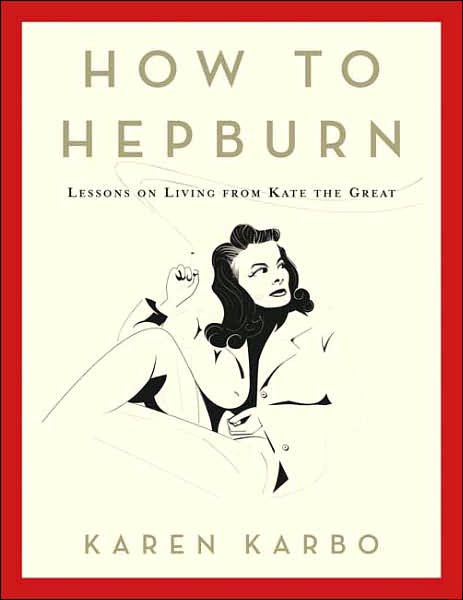
How to Hepburn: Lessons on Living from Kate the Great by Karen Karbo. (c) 2007, Bloomsbury USA, Biography

This little book came across my desk a couple of months ago and I was immediately smitten. Yes, Bringing Up Baby is one of my top five favorite movies of all time, and I spent a lot of time in college watching and ruminating on films by those iconic divas Hepburn, Garbo and Dietrich.

This book is not written with a particularly deferential air, and I'd like to think that Kate would have liked that. It's also not a filmography, nor a tell-all about the great actress' private life. Instead, it is a lively recitation of those characteristics of Hepburn that made her a remarkable character, both off-screen and on.

Chapters include: The importance of being brash, How to stick to your knitting, and Making the most of a dysfunctional relationship. I think even those who don't know much about Kate or haven't seen many of her movies would still enjoy this light read.

The anecdotes are brilliant. My favorite so far: One day Kate wore jeans onto the movie set, a move so outrageous that the powers-that-be sent a production assistant to take Hepburn's jeans while she was in the dressing room so that she would be "shamed" into wearing a skirt. Instead, Kate "traipsed around in her underwear until the jeans were returned."

Her brashness was not always appreciated. No, not even often. She was at times hated because her strong, androgynous, opinionated attitude went completely against what was expected of women, and women's film roles, of the time. Critics attacked her because she never looked convincing when the script called for her character to swoon into love. Karbo writes,

Long before Gloria Steinem observed that on some level all women are female impersonators, Hepburn was unwittingly showing it to be true. Hepburn did have a limited range, and the limit was acting insipid and submissive opposite a leading man who couldn't hold a candle to her. To make matters worse, Hepburn also managed to convey that she had other fish to fry, and there's nothing more dangerous than a woman who can't be brought to her knees by love.
The allusion to Steinem notwithstanding, Hepburn was no feminist. Karbo refers to her as intransigently "nonanalytical," refusing to think deeply, or perhaps at all, about her impact on women's roles. She was prudish about sexuality on film and fiercely hostile to the notion of mothers working outside the home.

Karbo also points out an irony that I had learned years ago but forgotten: while women's roles in society have expanded, the roles on film have withered. Karbo lists the female roles for the top ten grossing films from the fall of 2006, a list that includes Bond girl, mothers, girlfriends, wives and ex-wives, assistants and a nanny. Not one is a leading role. However, in 1938 some of the greatest actresses of the time were starring in films, leading the plot as night-club dancer (Joan Crawford), office worker (Ginger Rogers) and more. The point is that, while expectations of gender-roles were limited (marriage is the ultimate role for a woman, love is the primary destination), the women were the headliners, not the pretty/pathetic/passive secondaries.

In spite of her brilliance, Katharine Hepburn nearly fell into obscurity. Karbo points out that the only reason Hepburn became famous was that she simply refused to give up. She kept breaking the mold until society caught up with her.

That's why I like Kate.