I can't believe it's been nearly a month since I've blogged. Life jumped up and smacked me, what can I say? There's been good, bad and the ugly, and the sublimely beautiful too. And, as always, I've drafted the blog entries in my head, then the days and weekends end and I'm too exhausted from the busy, distracting work of living to actually take the time to sit and write. It's too bad. There have been some really good drafts in my head.Tuesday, April 28, 2009
Fishers and films
I can't believe it's been nearly a month since I've blogged. Life jumped up and smacked me, what can I say? There's been good, bad and the ugly, and the sublimely beautiful too. And, as always, I've drafted the blog entries in my head, then the days and weekends end and I'm too exhausted from the busy, distracting work of living to actually take the time to sit and write. It's too bad. There have been some really good drafts in my head.Tuesday, September 23, 2008
Homage to Brash Kate
Umm. Put the reviews here and just links to the side, perhaps? Yes, that should do nicely.
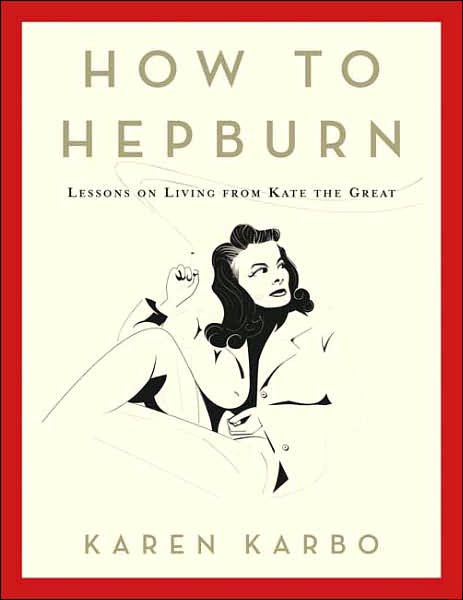
How to Hepburn: Lessons on Living from Kate the Great by Karen Karbo. (c) 2007, Bloomsbury USA, Biography
This little book came across my desk a couple of months ago and I was immediately smitten. Yes, Bringing Up Baby is one of my top five favorite movies of all time, and I spent a lot of time in college watching and ruminating on films by those iconic divas Hepburn, Garbo and Dietrich.
This book is not written with a particularly deferential air, and I'd like to think that Kate would have liked that. It's also not a filmography, nor a tell-all about the great actress' private life. Instead, it is a lively recitation of those characteristics of Hepburn that made her a remarkable character, both off-screen and on.
Chapters include: The importance of being brash, How to stick to your knitting, and Making the most of a dysfunctional relationship. I think even those who don't know much about Kate or haven't seen many of her movies would still enjoy this light read.
The anecdotes are brilliant. My favorite so far: One day Kate wore jeans onto the movie set, a move so outrageous that the powers-that-be sent a production assistant to take Hepburn's jeans while she was in the dressing room so that she would be "shamed" into wearing a skirt. Instead, Kate "traipsed around in her underwear until the jeans were returned."
Her brashness was not always appreciated. No, not even often. She was at times hated because her strong, androgynous, opinionated attitude went completely against what was expected of women, and women's film roles, of the time. Critics attacked her because she never looked convincing when the script called for her character to swoon into love. Karbo writes,
Long before Gloria Steinem observed that on some level all women are female impersonators, Hepburn was unwittingly showing it to be true. Hepburn did have a limited range, and the limit was acting insipid and submissive opposite a leading man who couldn't hold a candle to her. To make matters worse, Hepburn also managed to convey that she had other fish to fry, and there's nothing more dangerous than a woman who can't be brought to her knees by love.The allusion to Steinem notwithstanding, Hepburn was no feminist. Karbo refers to her as intransigently "nonanalytical," refusing to think deeply, or perhaps at all, about her impact on women's roles. She was prudish about sexuality on film and fiercely hostile to the notion of mothers working outside the home.
Karbo also points out an irony that I had learned years ago but forgotten: while women's roles in society have expanded, the roles on film have withered. Karbo lists the female roles for the top ten grossing films from the fall of 2006, a list that includes Bond girl, mothers, girlfriends, wives and ex-wives, assistants and a nanny. Not one is a leading role. However, in 1938 some of the greatest actresses of the time were starring in films, leading the plot as night-club dancer (Joan Crawford), office worker (Ginger Rogers) and more. The point is that, while expectations of gender-roles were limited (marriage is the ultimate role for a woman, love is the primary destination), the women were the headliners, not the pretty/pathetic/passive secondaries.
In spite of her brilliance, Katharine Hepburn nearly fell into obscurity. Karbo points out that the only reason Hepburn became famous was that she simply refused to give up. She kept breaking the mold until society caught up with her.
That's why I like Kate.
Tuesday, April 22, 2008
Video Recommendation: King Corn
First off, I just love documentaries and books like this: take a topic that seems so mundane and everyday and tease out the fascinating political, economic, and social issues that swirl around it.
The salient features:
1. Beginning in the 1970's, farmers were paid (by the gov't) to grow more corn than we as a country could reasonably use for food purposes.
2. Due to huge surpluses of corn, we developed new ways to use the grain, most notably animal feed and high-fructose corn syrup.
3. Cattle get sick living on a diet of primarily corn, and we get sick from taking in so much of the sweet/starchy corn-based additives in processed food.
My only complaint about the film is that it did not address the environmental impact of turning thousands and thousands of acres of land over to this monoculture -- it doesn't address pesticide use, loss of habitat and ecozones, drops in populations of indigenous bird and animal species, algae blooms in rivers and lakes due to fertilizer run-off, etc.
However, the filmmakers do a good job of providing a film that is both entertaining and thought-provoking. If you can't find a showing or the DVD, here's an interview with Curt Ellis, one of the filmmakers.
Monday, April 14, 2008
Freeheld on Friday
So, in case you are going to be in central Minnesota this weekend, check out the Film Festival. It'll be fun.
And if you can't make it, by all means try to see Freeheld, by Cynthia Wade. It's an amazing and inspiring film, and last month won the Academy Award for Best Documentary, Short Subject.