Friday, September 26, 2008


Thursday, September 25, 2008
Sending out a little hope
 I wrote a while ago about receiving a letter from Kodjo, the son of my best Togolese friend while I was in the Peace Corps. We've been e-mailing Kodjo regularly, and it's been great to re-form that connection after years of quiet. It has been heartbreaking as well, so much so that I hope you will forgive me as I step onto my soapbox.
Some of you may know, but most probably do not, that Togo has had a rough year. The economy is poor here, but it is devastatingly weak there. Prices for staples like rice and flour have soared as the US has redirected corn toward ethanol instead of food for people or animals. As if that weren't enough, Togo was hit with devastating floods in July, washing out bridges on the main highway, destroying homes and villages, and killing many people. This natural disaster has compounded the economic one because it has made travel and trade between the cities and outlying areas much more difficult.
The floods have brought a lot of misery to the region, but we've played our part as well. Just in case you are not clear on why we, US citizens, share at least some of the responsibility for the dire circumstances in places like Togo, here is a brief and basic synopsis.
The US has enormous power to force "Free Trade Agreements" on developing nations like Togo (the US / World Bank forgives and/or reconfigures national debt in return for signing on the dotted line). These trade agreements push developing nations away from growing enough of their staple food crops to be self-sustaining. Instead, Free Trade has meant that farmers in developing countries are encouraged to grow cash crops like coffee, cocoa and cotton, and to do so in such a way that many of the villagers are able to move to cities where they can make shoes, clothing and many of the things that allow Walmart to maintain its famously low prices. In return, developing countries import food crops such as corn and wheat that we grow in surplus. In the lovely land of theory, the benefit to this is that the local farmers will make money from the cash crops, more than enough to purchase the food they need, our corporate agri-business will have foreign markets for the food crops they grow across the midwest. Oh, and we'll be able to drive to the local mega-mart and buy "cheap plastic crap."
 And we ~ you, me, our families and neighbors ~ are culpable because we elect people and then pay little attention to what they agree to in international trade agreements or the farm bill. And too many of us never wonder whether there are consequences beyond our own bank accounts and immediate self-interest.
Now, throw corn-based ethanol into the mix, and the fields that were full of food-grade corn or wheat or barley are being used for ethanol-grade corn. Corn that was going to feed cattle is also redirected, the prices pushed up prohibitively high, and so the feed lots and ranchers purchase barley and other grains. The domino effect ensues, and the prices for these other grains skyrockets right along with corn.
However, the income for the farmers growing cotton in Togo has not risen, and they are using all their means to cultivate cotton so that they don't have enough food crops to feed their families. Look further east, and it's the same, as the rice paddies in Vietnam have been turned into coffee plantations to bring us our cheap cup of Folgers, and so the developing nations find themselves in the horrific place of having too few people on too few acres of arable land growing food crops. Food prices soar and people go hungry.
I saw this happening first-hand when I was a Peace Corps volunteer. I was sent to Togo to educate and encourage farmers ~ who had been hand-tilling small family plots of yams, corn, tomatoes, other food crops ~ to begin using oxen to till larger parcels of land. And to grow cotton. What I discovered was a situation that often resulted in the farmers becoming something like indentured servants. The Togolese government provided the loans for the cattle and accompanying training, as well as the loans for the cotton seed. Then, the government also set the price for cotton. The end result was that the absolute only way that a farmer could dig himself out of the debt incurred from purchasing oxen was to grow virtually no food, use all available land for cotton, and to dump loads of chemicals into the soil to produce the largest yields possible.
Oh, and I must point out that, while DDT and similar pesticides are banned in the US, there is still a thriving market for them in places like Togo. And, contrary to their manufacturer's evident hypothesis, the side-effects aren't lessened just because it's a developing nation.
So, back to our friends, Kodjo and Adjo, and their mother Afoua...
Kodjo is a student at Lome University, Adjo is in high school (and high school in Togo costs almost as much as the university). The rising prices have left them without funds for school, and Afoua is without enough for food. She is also chronically ill. So we are helping them.
I don't know if it makes it better or only more sad that for a little over $400 we can send Kodjo and Adjo to school for a year and provide Afoua with enough money for food and medicine. The money is not insignificant to us, but it's brutally significant to them. We will have to make adjustments, but they get education and some health care.
I am glad that our current presidential candidates are talking a lot about the economy. However, while they argue about tax cuts and job cuts and the banking and mortgage crisis for us, it is my very dear wish that they'd also think and talk a little about our influence in far-off, tiny countries like Togo.
Tuesday, September 23, 2008
Homage to Brash Kate
 I've been putting my book reviews on the side panel, and was happy with that until the other day when I couldn't remember the name of a book I'd read, and I knew that I'd written about it on my blog but ... oh... the shame... there are no tags and no record. What to do?
Umm. Put the reviews here and just links to the side, perhaps? Yes, that should do nicely.
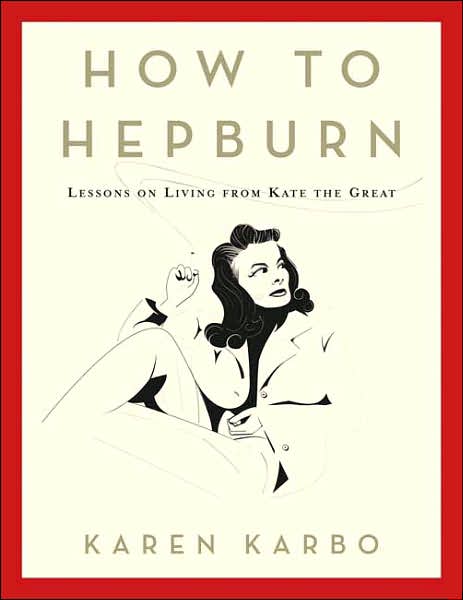
How to Hepburn: Lessons on Living from Kate the Great by Karen Karbo. (c) 2007, Bloomsbury USA, Biography
This little book came across my desk a couple of months ago and I was immediately smitten. Yes, Bringing Up Baby is one of my top five favorite movies of all time, and I spent a lot of time in college watching and ruminating on films by those iconic divas Hepburn, Garbo and Dietrich.
This book is not written with a particularly deferential air, and I'd like to think that Kate would have liked that. It's also not a filmography, nor a tell-all about the great actress' private life. Instead, it is a lively recitation of those characteristics of Hepburn that made her a remarkable character, both off-screen and on.
Chapters include: The importance of being brash, How to stick to your knitting, and Making the most of a dysfunctional relationship. I think even those who don't know much about Kate or haven't seen many of her movies would still enjoy this light read.
The anecdotes are brilliant. My favorite so far: One day Kate wore jeans onto the movie set, a move so outrageous that the powers-that-be sent a production assistant to take Hepburn's jeans while she was in the dressing room so that she would be "shamed" into wearing a skirt. Instead, Kate "traipsed around in her underwear until the jeans were returned."
Her brashness was not always appreciated. No, not even often. She was at times hated because her strong, androgynous, opinionated attitude went completely against what was expected of women, and women's film roles, of the time. Critics attacked her because she never looked convincing when the script called for her character to swoon into love. Karbo writes,
Long before Gloria Steinem observed that on some level all women are female impersonators, Hepburn was unwittingly showing it to be true. Hepburn did have a limited range, and the limit was acting insipid and submissive opposite a leading man who couldn't hold a candle to her. To make matters worse, Hepburn also managed to convey that she had other fish to fry, and there's nothing more dangerous than a woman who can't be brought to her knees by love.The allusion to Steinem notwithstanding, Hepburn was no feminist. Karbo refers to her as intransigently "nonanalytical," refusing to think deeply, or perhaps at all, about her impact on women's roles. She was prudish about sexuality on film and fiercely hostile to the notion of mothers working outside the home.
Karbo also points out an irony that I had learned years ago but forgotten: while women's roles in society have expanded, the roles on film have withered. Karbo lists the female roles for the top ten grossing films from the fall of 2006, a list that includes Bond girl, mothers, girlfriends, wives and ex-wives, assistants and a nanny. Not one is a leading role. However, in 1938 some of the greatest actresses of the time were starring in films, leading the plot as night-club dancer (Joan Crawford), office worker (Ginger Rogers) and more. The point is that, while expectations of gender-roles were limited (marriage is the ultimate role for a woman, love is the primary destination), the women were the headliners, not the pretty/pathetic/passive secondaries.
In spite of her brilliance, Katharine Hepburn nearly fell into obscurity. Karbo points out that the only reason Hepburn became famous was that she simply refused to give up. She kept breaking the mold until society caught up with her.
That's why I like Kate.
Monday, September 22, 2008
Love, Tacos and Universal Serendipity
 Ah, what a blissful weekend we had. Saturday was our big Whoo-hoo We Did It fete, and we spent the day hanging out with lots of friends and family. Our first guests (not counting Donna and Mary, who came early to help out) arrived around 3:30 in the afternoon. The last guest left after midnight. (And Donna & Mary stayed for breakfast on Sunday.) What a blast. I can't say enough how much it means to me to be surrounded by these friends and family who bring their love, joy and blessings. When I feel bruised and alone, these people make my world right.
As I said, our wonderful friends Donna and Mary came early, bearing cake. A few weeks ago we were talking with them and Mary said she wanted to make our wedding cake. We said, "Whoo-hoo!" Mary makes great and gorgeous cakes. She asked us what kinds of cake we liked and so we answered that she couldn't go wrong with chocolate, carrot or spice cakes. And we said, "Surprise us." My goodness, but did she ever take us up on the challenge! We were gifted with the most gorgeous three-tiered cake, the bottom layer was carrot, the middle layer chocolate, and, of course, the topper was spice. Cream-cheese frosting on the top and bottom, sour cream/chocolate in the middle, and roses all around. It gave a whole new meaning to "yummy."
With so much love and congratulations flowing, the day passed in bliss. People came in shifts, with no planning on our part, so we were able to spend good time with everyone and really enjoy the company. Some people brought appetizers, so the table was spread with great food. We also had a big gallon-sized donation jar out for the No On Proposition 8 Campaign, and our friends filled it up with bills. We didn't quite meet Brad Pitt's $100,000 contribution, but we did alright.
We served a taco bar, and I picked tacos because it seemed like something that would be easy to prepare ahead, could be set out and reheated in shifts, and would appeal to lots of people. It was only when I started cooking the almost 7 pounds of roast on Friday that I realized that I'd also stumbled upon the most beautiful serendipity. The recipe, Spicy Oven-Stewed Beef, came from a cookbook of my mother's (perhaps the Chevy's restaurant cookbook ~ I'm not sure because I added it to my binder collection before I became disciplined about noting the source on my copies). I'd prepared it before and really enjoyed it. However, on Friday as I was re-reading the recipe before starting, I also read the anecdote on the sidebar. It describes how the authors developed the recipe for their beef tacos after a great day skiing with the family at Sugar Pine Point State Park in Lake Tahoe: the exact place where Gabi and I got married on July 19th.
Now, if that isn't the universe saying "Hurrah!," then I don't know what is!
Spicy Oven-Stewed Beef
2 1/2 pounds boneless beef chuck roast
2 tablespoons olive or peanut oil
1/4 teaspoon ground coriander seed
3 whole allspice berries
1/4 teaspoon whole peppercorns
1 pound tomatoes, preferably plum, coarsely chopped
2 medium onions, coarsely chopped
2 large garlic cloves, coarsely chopped
1 1/2 teaspoons chopped fresh oregano or 1/2 teaspoon dried
1 tablespoon achiote paste or 2 teaspoons pure chili powder plus 1/2 teaspoon cayenne
1/2 teaspoon salt
1 cup dry red wine
2 cups water
18 corn or 12 flour tortillas, warmed or crisped just before serving
TOPPINGS
1 large onion, finely chopped
1/4 cup chopped fresh oregano leaves or 1 tablespoon dried
2 limes cut into 6 to 9 wedges each
1. Heat the oven to 400 degrees F.
2. Cut the chuck roast into pieces, about 3/4 inch thick by 1/2 inch long, trimming away any excess fat as you go.
3. Heat the oil in a large nonreactive stew pot over medium-high heat. Add as much meat as will fit in one uncrowded layer and cook until browned, about 4 minutes. Transfer to a bowl. Continue with another round until all the meat is browned.
4. While the meat browns, place the coriander, allspice, and peppercorns on a paper towel. Fold the towel over the spices and crush them with a mallet or hammer.
5. Return all the meat to the pot and add the crushed spices, tomatoes, chopped onions, garlic, oregano, achiote paste, salt, wine and water. Bring to a boil. Cover and place in oven. Cook until meat is tender, 1 1/4 hours. (This stew can also be cooked on top of the stove, covered, over medium heat. The timing is the same.)
6. To assemble, place about 1/3 cup of the stew filling in the center of a tortilla. Top with some finely chopped onion and a sprinkle of oregano. Squeeze a lime wedge over all. Fold and serve.
* When I made this for our fete I left the beef in somewhat larger chunks, cooked it a little longer than the recipe called for, and then shredded the beef after. The flavor is marvelous, and the filling makes great enchiladas as well. B.
Sunday, September 14, 2008
Silly, pretty things
I welcomed the change in weather with a bit of beading creativity, playing with colors and thread last night until I was nearly too tired to brush my teeth before bed. But oh, what fun. Now, the even more entertaining part: wear these new pretty things a few times to test the design and make sure it will wear well for whomever I decide to gift it to.
Anyway, it was entertaining enough for me that I thought I'd share.

This pretty one is made with five strands of stone chips strung on cotton thread. It's easy but fairly putzy when you add up all the knots between stones.

My first foray into memory wire: a cute little choker with glass beads and silver charms.

I had some memory wire left over so made a simple bracelet with glass and stone beads and a magnetic clasp. This one is a true experiment since it's made with leftover necklace-sized wire instead of bracelet-sized wire.

This last one uses a single circle stone that I found at one of my favorite bead stores in Duluth, plus two stones, on leather cord. I've made a few with a similar bead design, but I'm experimenting on this one with an adjustable cord length. Two slip knots should allow the wearer to adjust the length to suit different styles of clothing.
Friday, September 12, 2008
More Fact Checking
One accusation claims then-Mayor Palin threatened to fire Wasilla’s librarian for refusing to ban books from the town library. Some versions of the rumor come complete with a list of the books that Palin allegedly attempted to ban. Actually, Palin never asked that books be banned; no books were actually banned; and many of the books on the list that Palin supposedly wanted to censor weren't even in print at the time, proving that the list is a fabrication. The librarian was fired, but was told only that Palin felt she didn’t support her. She was re-hired the next day. The librarian never claimed that Palin threatened outright to fire her for refusing to ban books.
See the full article, with info on Special Needs funding, Creationism, and the Alaska secessionist movement here.
Wednesday, September 10, 2008
Royalton Library Centennial

The Royalton Library held its centennial celebration today. The ladies from the Royalton Woman's Study Club, the group that founded the library, held an open house with a historical display and refreshments. It was great fun to hang out and chat with everyone. I spent some time looking through the old ledgers and such. There were a couple of ledgers that listed all the books owned by the library and who had donated them.
I also discovered the notebook kept by the secretary of the Royalton Library Association, begun in April 1912. I found the Rules and Regulations passed for the library, and had to share.
Rules and Regulations of the Royalton Library Association
I. Adults living in the city or village of Royalton... are entitled to draw books by filling out application blanks. Children under the age of sixteen (16) must obtain the signature of parent or guardian.
II. Each person entitled to draw books from the library will be given a card, which must be presented whenever a book is taken, returned or renewed. If the card is lost, a new one will be given, after seven (7) days notice or upon payment of five cents.
III. One book at a time may be drawn on a card. Two volumes of the same work are considered as one book.
IV. Books may be kept for two weeks, and once renewed for the same time. Books marked "Seven Day Book" may be kept for that time only, but may be renewed once only for the same time.
V. A fine of one cent a day will be imposed for the books kept over time.
VI. A temporary resident may obtain a borrower's card by filling out an application blank and obtaining the signature of a resident-free holder, or by a temporary deposit, equal to the value of the book.
I found an inflation adjuster online and figured out that the five cents it cost in 1912 to replace a card would be $1.06. And we charge $1. Similarly, that 1 cent fine for overdues would be 21 cents today... and we charge 20 cents for adult items (10 cents for juvenile, and $1 for all videos). I think it is pretty amazing that these charges have remained relatively the same for a hundred years!
One more bit from the same document of 1912:
A motion was made and seconded that... all books, manuscripts and papers detrimental to the good morals and public order shall be barried from the library. Carried.
Personally, I much prefer the sentiment of Jo Godwin: A truly great library contains something in it to offend everyone.

 Posts
Posts